
Mafia Game Rules: How to Play Mafia and Werewolf [2026]
Mafia is the game every other social deduction game is descended from, and it is still the best argument for sitting a group of people in a circle and letting them lie to each other. It is also the one most groups give up on after two rounds, and not because the rules are hard. The rules are easy. The problem is that a standard game quietly takes two people out of the room and asks them to watch.
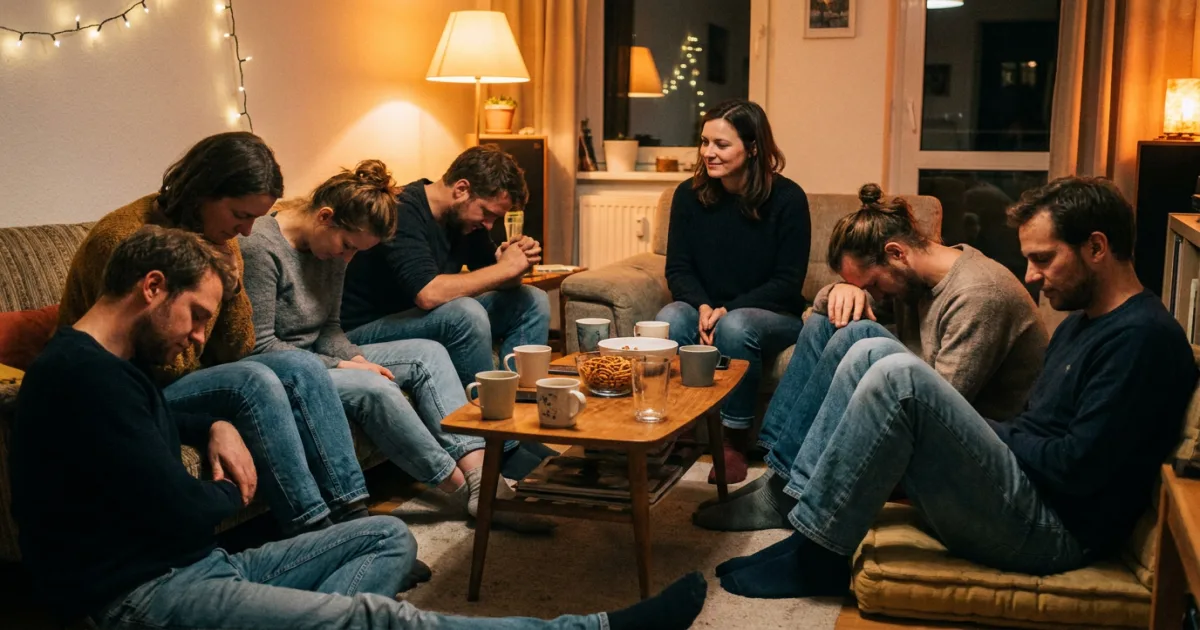
Those two people are the moderator, who runs the game and never plays it, and whoever gets killed on night one, who then sits in silence until the whole thing resolves. Neither is a house rule somebody invented. Both are in the game as designed, and both are doing real work.
So this guide does three things. It gives you the full ruleset in the order you actually need it. It settles the argument about how many mafia to use, with the one piece of research that has an answer. Then it deals with the sitting-out problem honestly, because pretending it is not there is why groups quit this game.
The Rules, Start to Finish
You need at least six players, and the game hits its stride around ten. Wikipedia's entry on the game dates it precisely: it is "a social deduction game created in 1986 by Dmitry Davidoff, then a psychology student at Moscow State University", first played in the spring of 1987 at the university's Psychology Department. Forty years later the core loop has not changed.
Setup. One person volunteers as moderator and does not take a role. Everyone else draws a role in secret, usually from shuffled cards or slips of paper. Most players are ordinary townspeople with no ability. A small minority are mafia, and they are the only players who know who their teammates are. The moderator holds the complete picture and reveals none of it.
The night phase. Everyone closes their eyes. The moderator asks the mafia to open theirs, and they silently agree on one player to eliminate, pointing rather than speaking. If you are using special roles, the moderator wakes each of them in turn. Then everybody closes their eyes again.
The day phase. The moderator announces who died overnight. The survivors argue, accuse each other, and vote to eliminate one suspect. The same source describes the whole structure as "two alternating phases: first, a night-phase, during which those with night-killing-powers may covertly kill other players, and second, a day-phase, in which all surviving players debate and vote to eliminate a suspect". That is the entire game engine. Everything else is decoration.
Winning. The town wins the moment the last mafioso is eliminated. The mafia win the moment they equal or outnumber the remaining townspeople, because from that point they can simply vote as a bloc and no outcome changes it. Call the game there rather than playing out the formality.
Optional roles. The detective checks one player's allegiance each night and learns the truth. The doctor protects one player each night, canceling the kill if they guess right. Add them one at a time and only once your group has played a plain round, because each one changes the balance more than it looks like it should.
How Many Mafia You Actually Need
This is the argument every group has, and there are three answers in circulation. Davidoff's original rules suggest a third of the players, rounded to the nearest whole number. Andrew Plotkin, who wrote the Werewolf version of the rules, recommends exactly two mafiosi regardless of table size. Most internet lists split the difference and guess.
There is actual research on this. Mark Braverman, Omid Etesami and Elchanan Mossel published Mafia: A theoretical study of players and coalitions in a partial information environment in 2008, modeling the game as a mathematical object. For a game with no detective, they found the two sides have comparable chances of winning "exactly when the total population size is R and the mafia size is of order sqrt(R)". In plain terms: the square root of your player count.
Ten players gives you about three mafia. Sixteen players gives you four. That is close to Davidoff's third at small tables and well below it at big ones, which matches what most experienced groups arrive at by trial and error. The same paper found that adding even a single detective swings the balance hard toward the town, far enough that the mafia would need a size linear in the player count rather than its square root to stay level. Read that the way it is meant: a detective is not a free garnish. If you add one, add a mafioso to pay for it.
- 6 to 8 players: 2 mafia, no special roles. Learn the rhythm first.
- 9 to 12 players: 3 mafia with no detective. Want a detective? Make it 4 mafia, not 2.
- 13 to 18 players: 4 mafia plain, 5 once a detective is in. A doctor on top does not need a sixth. Past 18 the day phase turns into a queue.
One more lever, and it is free. Plotkin also points out that "the humans' chances are significantly weaker when there are an even number of players (including the moderator)", because even counts tend to end on a night kill rather than a vote. Count the moderator in when you do that arithmetic: ten at the table plus a moderator is eleven, which is the parity you want.
Mafia or Werewolf? Same Game, Different Coat
If half your group calls it Werewolf and the other half calls it Mafia, they are both right and nobody has to concede. The ruleset is identical. Plotkin is direct about it on his own rules page: "I did not invent this game; Dimitry Davidoff did, in 1986." He picked it up at the 1997 National Puzzlers' League convention under the name Mafia and changed the theme for a reason he states just as plainly: "I think werewolves are niftier, so I changed it."
The retheme was not cosmetic in its effect. Wikipedia records his argument that the mafia framing had less cultural resonance and that "the werewolf concept fit the idea of a hidden enemy who looked normal during the daytime". It also changed who was willing to play. "Pick a villager to lynch" and "pick someone to shoot" land very differently at a family table, which is worth knowing before you explain the rules to a room that includes your aunt.
The Two Rules That Quietly Bench Two People
Here is the part the rules pages state and then move past. Wikipedia is unambiguous on the first one: "Live games require a moderator who does not participate as a player." Not a preference. The moderator is the only person holding complete information, so they cannot hold a role as well without breaking the game.
The second rule is that the dead stay dead and stay quiet. Wikipedia puts it as "dead players are not permitted to attempt to influence the remainder of the game". Plotkin is blunter, and includes himself in the warning: it is "really important that dead players not speak, and the moderator not speak outside his official capacity", and that holds even for "a blatant misstatement about a matter of record".
Both rules are correct. Both are also expensive. Run the arithmetic on a group of seven: one moderator plus one night-one victim means two people are spectators before anybody has said a word, and five are playing. After the first vote it is three and four. Barely into your party game, nearly half the room is watching.
You can see what happens next coming. The spectators start whispering. Somebody who knows exactly who the mafia are lets a look slip at the wrong moment, and the table reads it instantly. Moderate enough rounds and you learn the game rarely dies from a rules dispute. It dies because the people who were eliminated got bored and became a second, worse source of information.
That is the specific problem Bluffin (formerly Impostor Who) was built around. The phone deals the secret roles and keeps the hidden information, so nobody has to give up their evening to be the moderator, and rounds are short enough that nobody spends twenty minutes as furniture. If you want the mechanics side by side, we wrote a direct comparison with Mafia.
Strategy: Stop Reading Faces
Almost every Mafia strategy guide tells you to watch for nervous tells. The evidence says that is close to worthless. Charles Bond and Bella DePaulo pooled 206 documents covering 24,483 judges for Accuracy of deception judgments, published in Personality and Social Psychology Review in 2006. The headline finding: "people achieve an average of 54% correct lie-truth judgments, correctly classifying 47% of lies as deceptive and 61% of truths as nondeceptive".
Four percentage points above a coin flip, with a built-in bias toward believing whoever is talking. Your certainty that Sarah's laugh was off is not evidence. It feels like evidence, which is exactly why it costs the town so many rounds.
What does carry information is behavior you can write down. Track who voted with whom and who changed their vote once the count was already decided. Notice who spends the day phase agreeing with the majority without ever nominating anyone, because mafia want a townsperson eliminated but do not want their fingerprints on the decision. Notice who defended the player who turned out to be mafia, and who went quiet immediately afterwards.
Playing as mafia, the counter is the same in reverse. Be useful out loud from the first day. Nominate someone, give an ordinary reason, and be wrong occasionally in the way a townsperson is wrong. The mafia who says nothing on day one is the mafia who gets voted out on day two, every time. If you want more games built on the same read-the-room skill, our guide to Spyfall alternatives covers the closest relatives.
Five Ways Groups Ruin This Game
- Stacking special roles on round one. A detective, a doctor, a vigilante and a jester in a nine-player game is not a richer experience, it is a twenty-minute night phase.
- A moderator who reacts. A pause before announcing a death, a change in tone, a glance at the right person. It leaks constantly and the moderator is always the last to notice.
- Unlimited day phases. Put five minutes on a timer. A vote forced by a clock is a better game than a debate that outlasts everyone's attention.
- Punishing a wrong vote socially. Getting the town to eliminate an innocent player is the mafia doing their job well. If your table treats it as a personal failure, people start voting to stay safe instead of voting to win.
- Playing with five people. Six is the floor, and it is a low floor. Under that, one night kill decides everything before the arguing starts.
Frequently Asked Questions
How many people do you need to play Mafia?
At least six, and ten for a classic game. Below six, a single night kill removes too large a share of the table for the day phase to be interesting. If you can pick your number, count the moderator in and aim for an odd headcount: ten players plus a moderator is eleven. Even headcounts tend to end on a night kill, and that favors the mafia.
What is the difference between Mafia and Werewolf?
Nothing mechanical. Dmitry Davidoff created Mafia in 1986 at Moscow State University, and Andrew Plotkin rethemed it as Werewolf in 1997 because he thought the hidden monster framing suited a hidden enemy who looks normal by day. The phases, roles and win conditions are the same game.
How many mafia should there be in a 10 player game?
Three if you are playing without a detective, which is roughly the square root of the player count that Braverman, Etesami and Mossel identified as the balance point in their 2008 study. Go up to four if you add a detective, because the same study found a single detective shifts the odds toward the town far enough that the mafia have to grow faster than the square root to keep pace.
Can you play Mafia without a moderator?
Not the classic live version. The rules require a moderator who does not play, because someone has to hold the hidden information and run the night phase. The only way around it is to give that job to software, which is what phone-based social deduction games do: the app deals the secret roles, so everyone in the room gets to play.
If You Want the Game Without the Bench
Play Mafia properly at least once. The moment a table turns on an innocent player with total confidence is worth the setup, and no app reproduces the sound a room makes when the vote goes the wrong way.
For the other four nights of the month, when nobody wants to moderate and you have eleven minutes before the food arrives, a phone-based round covers it. The closest relatives are laid out in our guide to the impostor game and its rules, and if your group came to this from a video game rather than a card deck, the Among Us alternatives for iPhone list is the better starting point.
No Moderator, No Spectators, One Phone.
Bluffin deals the secret roles, runs the turn order and keeps the hidden information, so the person who would have been stuck moderating gets to sit in the circle and bluff like everyone else. Hand the phone to your left and find out who is lying.
Related Articles
![Never Have I Ever: 90 Questions and How to Play It Without the Drinking [2026]](/blog/never-have-i-ever-questions/cover.webp)
Never Have I Ever: 90 Questions and How to Play It Without the Drinking [2026]
90 Never Have I Ever questions plus the finger count rules, no drinking needed. Warm-up, travel, work, cringe and relationship sets for any group size.
Read More
Two Truths and a Lie Ideas: 75 Examples and the One Trick to Win
Two truths and a lie ideas for work, parties, school, family, and video calls, plus the one trick that fools everyone. 75 ready-to-use examples inside.
Read More
Best Online Bluffer Games for Groups in 2026
The 11 best bluffer games 2026 has to offer: Among Us alternatives, free and paid social deduction picks verified and ranked for groups of 3-16. Facts checked against Steam + Wikipedia.
Read More